Showing posts with label Native Plants. Show all posts

Sunday, June 8, 2014

Native Plants I Love

Amsonia tabernaemontana (Common Name: Eastern blue star)

Another lovely blue star, this species begins blooming about a week or two later than its cousin Amsonia hubrichtii.  As its common name name would suggest, Amsonia tabernaemontana also features blue, star-shaped flowers that appear in terminal clusters atop stems that reach 2-3 ft. tall. The foliage on this plant, however, resembles willow-leaves, rather than hubrichtii's feathery appearance, and the flowers are a darker blue. 

Close up of flower clusters

Eastern blue star is native to the central and eastern U.S. It can be grown in full sun to part shade. Multiple stems grow from a central core and create a mounding form 2-3 feet wide. We have a handful of these plants interspersed in a bed that contains our serviceberry trees, ornamental grasses, and assorted other native perennials (including Amsonia hubrichtii). The bed gets full sun, we haven't had to water since the first summer we planted it, and there is something cool to look at pretty much all year long.

The two photos above were taken in mid-may. Not sure when the photo below was taken, as it isn't one of mine, but obviously sometime in the fall. Like its relative, this blue star also puts on a fall show.


Sunday, June 1, 2014

Native Plants I Love

Rhododendron catawbiense (Common Name: Catawba rhododendron)

An evergreen shrub that can tolerate shade and produces gorgeous clusters of rosy purple flowers?  Awww yeah. 

Catawba rhododendron is native to the southern Appalachian mountains from Virginia to Georgia and can be used in a variety of ways in the landscape. They are stunning massed in a line where open yard meets more wooded areas. Because they keep their leaves year-round, they are effective foundation plantings, especially around raised porches and decks because of their potentially large size. They also make lovely specimen plants, with a flush of spring flowers and pretty green foliage all year long. 

Rhododendrons prefer bright shade and acidic soil, so you may need to amend your soil to keep them thriving (pine-needle mulch is an easy way to do this). They typically grow 6'-10' tall with an equal spread, so be sure to give them some room to grow.


The plant in the photo above is about 3 feet tall and wide, and has been sited so that it will eventually fill that corner and screen the underside of our deck. We planted it last spring, added some fertilizer for acid-loving plants to the planting hole, watered it in for a few weeks, and have let it alone since then. It is located near an enormous American holly tree whose dropped leaves provide a regular injection of acidification.  

Sunday, May 18, 2014

Native Plants I Love

Wisteria frutescens (common name: American wisteria)

Do not confuse this lovely native wisteria with the vine that is eating the southeast. Chinese wisteria, while admittedly beautiful, is highly invasive and should never be planted by the home gardener. Wisteria frutescens is a deciduous woody vine that can grow to 30' or more. It features drooping clusters of fragrant, purple flowers in April and May, with occasional rebloom during the summer, particularly if the vine is lightly pruned after initial flowering.

"Amethyst Falls" wisteria vine on our back deck this morning

American wisteria likes full sun and does not like to be transplanted, so plant it and let it be. Like most vines, it will benefit from regular pruning to remove dead wood and to control the size and shape of the plant. We have planted the named variety "Amethyst Falls" in containers at the base of a pergola covering our back deck. In a few years, the vines should grow up the posts, meet overhead, and create a lovely shaded room during the summer, while letting the sun shine through after dropping leaves in fall. 

Sunday, May 4, 2014

Native Plants I Love

Amsonia hubrichtii (common name: Threadleaf Blue Star)

Blue star is a showy, three-season perennial that is finally starting to get the attention I think it deserves.  From winter dormancy, foliage emerges in early spring, and the narrow, strappy leaves resemble those of the true lily from a distance. In April and May, clusters of powder-blue, star-shaped flowers appear atop stems that grow 2-3 feet tall.  

Terminal flower clusters are made up of dozens of individual blossoms.

During summer, the bright green foliage makes a nice backdrop for later flowering plants, and the waving, feathery stalks provide nice movement in the garden. I have a handful of these running in a curved line through a front garden bed, because in addition to their gorgeous early flowers, blue star does this in the fall:

absolutely spectacular as a mass planting

Sunday, April 27, 2014

Native Plants I Love

Amelanchier canadensis (common name: serviceberry)

This is a really great small tree or multi-stemmed large shrub that provides 3-seasons of interest in the garden. Amelanchiers are incredibly low-maintenance; have pretty flowers and vivid fall color; plus they produce fruit reminiscent of blueberries in the summer. It is a mystery to me why this one is not used more often as a landscaping plant. We have three in our yard, and I love them.

Fall foliage

Serviceberry is native to eastern North America, can be planted in full sun to part-shade, and will  tolerate clay soils. They grow 20-30 ft. high with a 15-20 ft. spread. White flowers bloom in early spring before leaves appear (early-mid april for us here in N.C.).

Berries are really tasty.

Sunday, April 20, 2014

Native Plants I Love

Fothergilla major (common name: witch-alder)

Fothergilla is a deciduous shrub native to the southeastern U.S. As its common name suggests, it is a relative of our native witch-hazel. I love this plant because there is nothing else like it, with its bottlebrush-like, white flowers that bloom in April here in the Piedmont of N.C.

Close up of flowers taken this morning

Witch-alder can be planted in sun or part shade and is very low maintenance. We use them as  foundation shrubs in front of some evergreen Japanese hollies (ilex crenata) put in by the previous homeowners. The dark green of the hollies creates a great backdrop for the Fothergilla's white flowers and striking fall foliage. The flowers also have a lovely honey-like scent, which is nice to have by the front entrance.

Fall foliage adds another season of interest

The genus is named for John Fothergill, an 18th century Quaker physician from Essex, England who was an early collector of American plants.

Sunday, April 6, 2014

Native Plants I Love

Cercis canadensis (Common Name: Eastern Redbud Tree)

An absolute stunner, and a welcome sign that spring is finally here. Redbuds are deciduous, understory trees found throughout central and eastern North America, from Canada down to Central America. They are typically found in open woodlands and woodland margins, which makes redbuds great landscaping trees because they can take full sun and part-shade. 

The common name comes from the red color of the flower buds (duh), but the flowers themselves are a beautiful rosy purple. They flower on bare branches before almost every other native woody plant, providing us with all of those stunning flashes of purple as we drive down the highway this time of year. Redbuds prefer moderately fertile soil with regular moisture, but not wet or poorly-drained locations. They also do not like to be transplanted, so plant while young and leave undisturbed.

If you are looking for a showy tree for your yard, try this home-grown beauty in place of Yoshino cherries or Bradford pears.

Buds just starting to flower on the tree in our front yard

"Forest Pansy" is a striking cultivar featuring purple leaves tinged with green

Sunday, March 30, 2014

Native Plants I Love


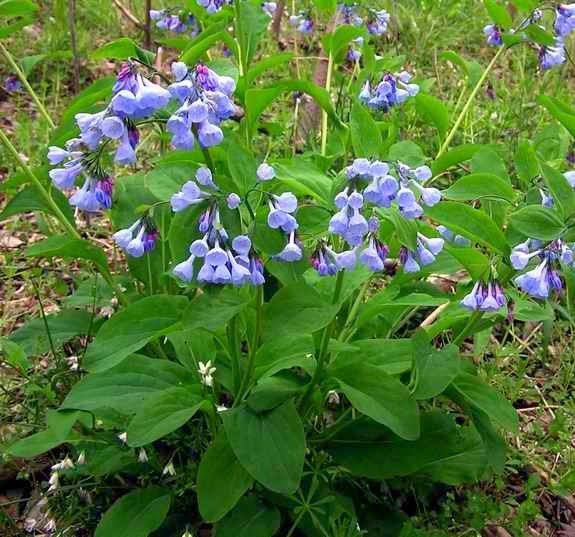
Mertensia virginica (Common name: Virginia Bluebells)

Another spring ephemeral that makes an appearance early in the season, wows us with its spectacular color, and disappears completely when the weather turns hot.

Bluebells thrive in deciduous shade and average-to-moist soil. They grow 1-2 ft. tall and will self-sow to create a lovely colony of nodding blue flowers that are (woo hoo!) deer resistant. 

I planted a few of these under some trees in our backyard, interspersed with some ferns that give cover when the bluebells go dormant. After the first few weeks of watering them in, I haven’t touched them, and each year, a few more plants make an appearance.

Our cold, rainy spring has delayed their emergence this year, but I took these two photos this morning:


Mertensia foliage just peeking through leaves in foreground


Flower spike and buds starting to emerge on this plant

Sunday, March 23, 2014

Native Plants I Love

I'm a big advocate of using native plants in the garden. They are adapted to our climate, have evolved to harmonize with our insect population, and can be just as interesting and beautiful as non-native exotics. Plus you don't have to worry about them jumping the fence, invading the landscape, and choking out everything in their path.

This delicate spring ephemeral is Erythronium americanum (common names: trout lily, dogtooth violet). They are scattered throughout the woods behind my house,where I took these pictures.

Trout lilies grow from corms and send out stolons from them, forming colonies over time if left undisturbed. They grow best in a deciduous woodland environment, with filtered sunlight and humus-rich soil. They are some of the earliest bloomers in the spring, and by the end of the season, flower, foliage and all disappear, remaining dormant until the following spring.